
Fear & Greed Q&A: What’s really under the hood of your investments?
Originally appeared in Fear & greed


Not all credit strategies carry the same risks, especially during periods of market stress.
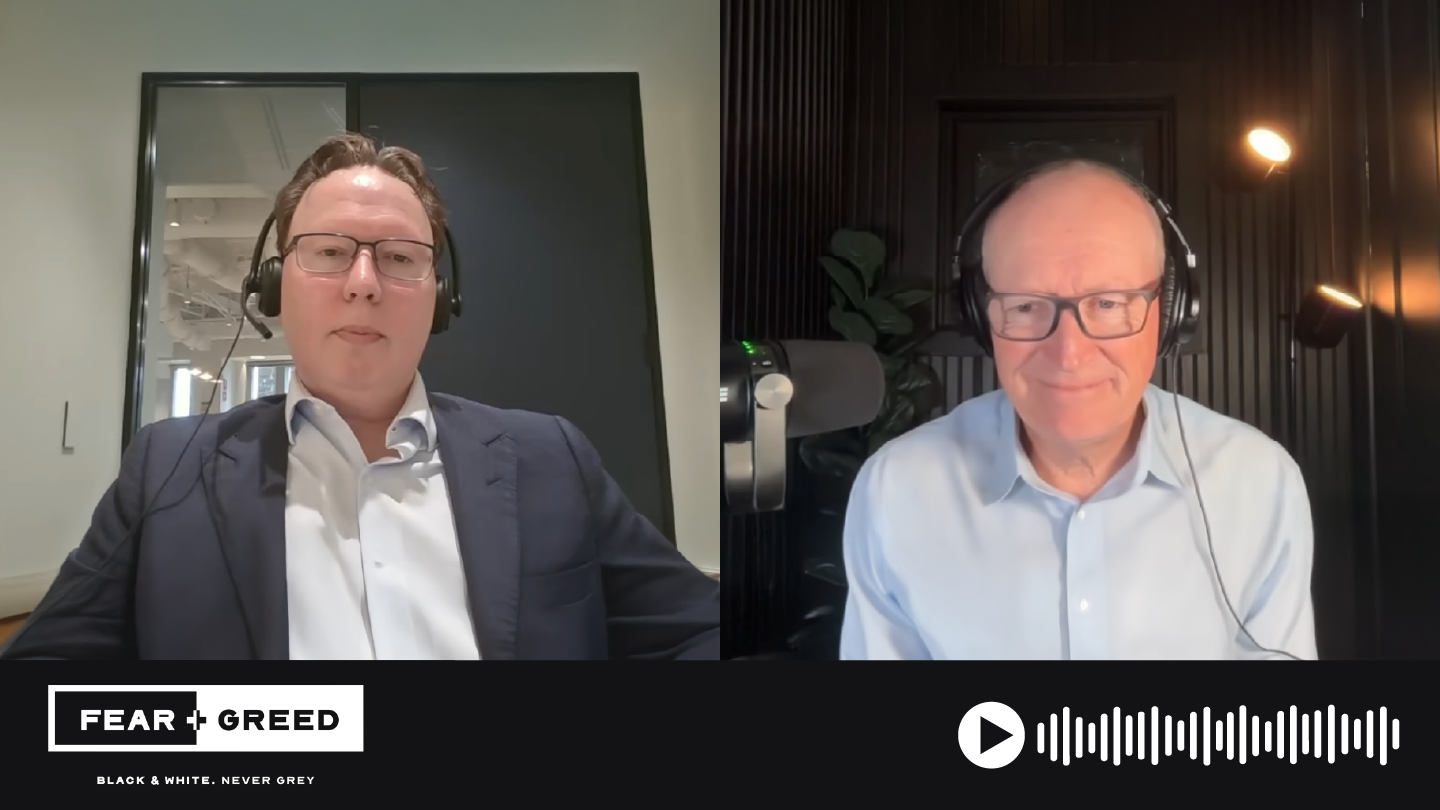
Michael Frearson, CFA, our Executive Director and Head of Fixed Income, recently joined Sean Aylmer on Fear & Greed to discuss why investors need to understand what sits underneath their fixed income and private credit investments.
Michael highlighted that the Australian credit market has faced two major tests: the global financial crisis and the early 1990s recession. While arrears rose during those periods, losses across major bank mortgage portfolios and investment-grade securitised credit remained very limited.
As Michael explained: “Even under very severe stress, the mortgage market, which is the largest asset class in the country, backed in all of the banks’ balance sheets, is actually very high quality and very stable during times of extreme stress.”
He added that, at RAM, our credit strategies are deliberately biased towards secured, domestic, first registered residential mortgages, supported by low loan-to-value ratios, diversified loan pools and floating-rate income streams. This focus is designed to support capital stability and regular income through different market conditions.
Michael also noted that the portfolios underpinning RAM’s credit strategies, including the Real Income Fund and RAM Secured Income Notes, continue to perform strongly, with 90-day arrears of just 0.22% across more than 7,000 loans, comparing favourably to major bank arrears.
Listen to the full interview here:
Sean Aylmer:
Welcome to Fear & Greed Q&A, where we ask and answer questions about business investing, economics, politics and more. I’m Sean Aylmer. Over the past few years, Australian investors have poured billions of dollars into things like private credit and income strategies. But as rates have risen and global credit markets have come under pressure, some investors are perhaps panic selling, suggesting they may not quite know the true value of the underlying asset of the investments they hold. My guest today is Michael Frearson, Head of Fixed Income at Real Asset Management, RAM. RAM works with Blue Chip Communications, which is a great supporter of this podcast. Michael has spent more than two decades in fixed income and says the key to investing now is to know what assets underpin what you’re holding. Remember, this is general information only and you should always seek advice tailored to your circumstances before making investment decisions. Michael, welcome to Fear & Greed Q&A.
Michael Frearson:
Well, thank you, Sean. It’s great to be here with you to discuss this.
Sean Aylmer:
So, for many of us investing in fixed income, that term fixed income, it’s kind of this black box. But I think what we need from you, what I’m wondering from you, is really a 101 on the importance of understanding what you’re actually investing in, what the underlying asset is.
Michael Frearson:
Yeah, thanks, Sean. It’s a very broad question because it is a very broad asset class. I’ll try to demystify it for you. Effectively, when you’re investing in fixed income, you’re lending money to someone. If it’s a bond, it’s just literally you’re lending money to that company. If it’s a loan, you’re lending money to an individual or a company and they promise to pay you back in accordance with the terms of that loan. So, at its simplest, it’s the investors giving their capital to someone with the hope that they get it paid back and get paid the promised income stream. So, within fixed income, there’s a very broad range of different types of fixed income. There’s obviously fixed rate fixed income, which promises to pay you a fixed rate of return, or there’s floating rate fixed income, which goes up and down with movements in the cash rate. But the two key risks investors face in all fixed income is either interest rate risk or credit risk. The other key difference is there’s public market credit exposure, which are things like bonds, which trade in the over-the-counter market or on the Australian Stock Exchange, or there is private market fixed income, which is a growing asset class.
Sean Aylmer:
That’s actually a very clear explanation of what’s going on here. So that’s good. Well, let’s talk about private credit and income funds over the past few years. We’ve heard a lot about them. What are people buying? What have people been buying? And where are they finding themselves at the moment?
Michael Frearson:
So, private credit is, again, a very broad asset class with a range of different sub-sectors within private credit. So, in Australia, investors have been attracted to both the high returns available from private credit, as well as the capital stability, given the floating rate assets. So that means they don’t go up and down when interest rates go up. Given the property obsessed culture we are part of, the majority of private credit domestically is backed by property. And then it can be a wide range of different types of property. So, it can be commercial property, it could be residential mortgages. The other key area of domestic private credit is corporate private credit, where large non-banks lend to both small and large corporates in either a secured or unsecured loan. But then that’s a different risk profile given it has the business risk. It’s not just secured by private assets.
Sean Aylmer:
Okay, so let’s take the next step then. So, I’m with you so far. That all sounds quite sensible and you get your return. Fantastic in good times, I’m sure, and particularly in low interest rate environments. But of course, what we’re seeing now are rising interest rate environments, fears of a slowdown in economic growth. How does that affect the different sides of the market, particularly the private market I’m talking about here. And how should investors think about that when they’re kind of, we’re all for long-term investing at Fear & Greed and what we don’t want to be, if things don’t look good right now, how should investors play their portfolio?
Michael Frearson:
Sure. I guess the other key sub-sector, which I didn’t mention, was offshore private credit. So that’s where you’re lending a lot of money to offshore groups, generally into corporate type loans and into venture capital type debt. So, like at the moment with the risk aversion increasing due to the oil price shock and the uncertainty, risk aversion has increased. So, at the moment, investors are a bit fearful, and they have been indiscriminately selling off some of their assets, particularly earlier in March, but the market has started to recover nicely over the last few weeks. So, some of that sentiment impacting the listed prices is more sentiment than any fundamental credit concerns with the outlook for the domestic market. But where we believe that investor concerns are warranted is for the groups that have offshore private credit exposure in their portfolios, given there are some more serious concerns about that offshore corporate private credit than the domestic private credit market.
Sean Aylmer:
Okay, so sort of reading between the lines there. In a sense, because our residential property market here is so strong and has been and will remain that way, but the offshore credit market is slightly more problematic. What should investors be focusing on then? Is it about diversification? Is it about trying to have a bias towards one, not the other? How should they think about it?
Michael Frearson:
Yeah, obviously it’s very important to have a well-diversified portfolio in any fixed income portfolio, given the key risk is that credit risk. So, I think rule number 1 is to really understand what is under the hood and what’s driving the returns on that particular investment. So, you need to know what risk factors you’re exposed to, be it either property development, be it offshore, or be it domestic simple securitised mortgages.
Sean Aylmer:
Okay, so you understand that, but in terms of your portfolio, do you need a bit of all or do you need a bias towards one, not the others?
Michael Frearson:
At RAM, we have an ASX-listed note called RAM Secured Income Notes. We also have the Real Income Fund. Both of these investments are backed by the same quality of assets. At RAM, we bias the portfolio to secured residential first mortgages that are domestic only. They are 100% Australian first registered mortgages with a low LVR. There’s a lot of security in the portfolio. We have a very diversified portfolio. Step number 1, we have security and that comes to the capital stability. The other thing we bias the portfolio is to deliver regular income for our investors. We have over 7,000 individual home loans, which provide that regular monthly income to investors. And it also means there’s negligible credit risk investors are exposed to. The key thing in the current environment, besides focusing on quality, is to bias the portfolio to floating rate. So floating rate income streams will benefit if the RBA raises the interest rates again next week, like the market currently expects them to.
Sean Aylmer:
Okay. If things get worse, unemployment rises, interest rates rise, we have falling house prices. How concerned are you about that?
Michael Frearson:
We’re not concerned about that at all in the current environment, given both the quality of our particular portfolio, our 90-day arrears in our portfolio are only 0.22% across the entire 7,000 loans. So that compares very favourably compared to the major banks, for example, which are 0.8 to 1% in the 90-day arrears. But additionally, if we look through history to understand how different investors behave during times of extreme market conditions, there’s been two key tests domestically which have impacted the Australian credit markets. So, during the global financial crisis, there was a lot of funding uncertainty. There was a big spike in home loan arrears, but that didn’t follow through to any losses across the major banks or in any of the investment grade securitised credit investments. But if we go back further to the 1992 recession, that provides some of the most meaningful data and comparisons we have. During the 1992 recession, there was a spike in unemployment. Interest rates were very high before they fell. But during that period, I think the loss rate on the ANZ portfolio was 11 basis points across their mortgage book. The loss rate on their commercial property book was 23.2%. Very big difference. And APRA has assumed hard lending risk for the industry of 18 basis points. So, it highlights that even under very severe stress, the mortgage market, which is the largest asset class in the country, backed in all of the banks’ balance sheets, it’s actually very high quality and very stable during times of extreme stress.
Sean Aylmer:
So, it means that the moral of the story, and we are not an investment podcast, always go to a financial advisor and get your own advice for your own circumstances, but investing in fixed income in residential property in Australia is a relatively safe bet. I say relatively because that we’re comparing to offshore and other places, but you know, 11 basis points in a recession, that ain’t bad.
Michael Frearson:
Yeah, thanks, Sean. But that’s also conditional on having a well-diversified portfolio and low LVR. So obviously there’s much greater risk if you lend at 100%.
Sean Aylmer:
Yeah, of course. Michael, thanks for talking to Fear & Greed.
Michael Frearson:
Great. Thank you, Sean.
Sean Aylmer:
That was Michael Frierson, Head of Fixed Income at Real Asset Management. Remember, this is general information only and you should seek advice tailored to your circumstances before making investment decisions. I’m Sean Aylmer and this is Fear & Greed Q&A.


